Saturday, May 25, 2013

Contemplative teaching

 
Green Heron CC*BY Anita Ritenour

Wading in

September 14, 2011
Ebbens’ (1996) comprehensive look at contemplative teaching is a bit overwhelming. … Will I be able to hold all these things together if this is what it takes to be contemplative? I feel a weight in my chest, suggesting that the answer is, “it would take a miracle.” … But, with the big picture in mind, there’s nothing else to do but take a deep breath and simply be fully present in this moment (Kessler, 2000, p. 22). I meditate daily. I remind myself moment-to-moment to stay open, to accept situations as they are, let things speak for themselves, see the facts and register them precisely, and not ignore the unpleasant aspects of what I see and feel (Ebbens, 1996, p. 3). I hope I’ve got it right -- this is the basic path of contemplative education. For the moment I just need to focus on the moment. At least that seems doable (Harper, 2011a, p. 2).
Looking back on that first fall semester of the Naropa Contemplative Education Master’s Program, I see that I had very little understanding of contemplative teaching. I was flailing around, drowning in the sea of all that I had learned over the summer semester, the “Summer Intensive” as it’s aptly described, grasping for the little rafts where I knew I could rest, like returning to the present moment. But about halfway through that semester, I began to get it. It really wasn’t so complicated as it seemed at first. It came down to being off the cushion more like I was on it. Simple enough!
November 7, 2011
Brown’s article, Taming our Emotions, contained in the collection of essays, Nurturing our Wholeness (Miller & Nakagawa, 2005, p. 3) … defined contemplative education in a way I could live with now, rather than imagine striving towards someday. “Rinpoche suggested that we should manifest the effects of our practice of meditation in our everyday teaching. This he called ‘contemplative education,’ …” (2005, p. 4).

As our readings unfolded and built upon each other over these six weeks, I found the emphasis on speech and silence, slowing down of experience to see the five skandhas, and befriending … impatience, to be intimately related and integral to my ability to manifest the effects of meditation practice in the classroom, that is, to teach contemplatively (Harper, 2011c, p. 1).

Ah, yes. I had read this exact thing on the program Website when I first visited to learn about contemplative education. As the semester continued, I ‘remembered’ more and more of what I had once known, but forgotten:
October 12, 2011
“The most important thing any teacher has to learn, not to be learned in any school of education I ever heard of, can be expressed in seven words: Learning is not the product of teaching. Learning is the product of the activity of learners” (Holt, 1984, p. 10). This seems to have become a part of who I am as a [student]. I believe learning is personal, it’s active, and it flourishes without outside direction (Harper, 2011b, p. 1).

By spring, 2012, I could put into everyday practice a few of the things we were learning. Faculty at the University of Texas invite me to give lectures on copyright for their students and these really began to change when I tried integrating contemplative practices.

May 5, 2012

“…giving students a voice that is heard and to do it in such a way that the dialog continues” (Palmer, 1997, p. 120 cited in Brown, 2012a, p. 2) … is easy to do. I quickly found that if I began my lectures by inviting the participants to ask questions right then, the lectures gradually disappeared! No kidding! After only a month of inviting questions at the start, my lectures went from about 30 minutes … to 0 minutes. The entire hour was taken up with discussion around student questions. Further, the topics I would have covered in the lecture were still, for the most part, covered, but in the context of factual settings intrinsically of interest to the students. This change facilitated an accommodation to another of Palmer’s suggestions – that we can reduce what we teach to the essentials: “Palmer writes about a fundamental challenge in our attempts to integrate contemplative practice into content-driven education: lack of space (time)” (Ibid., p. 7).

Turning over the role for directing the interaction to the students had other benefits as well: “By expanding beyond ourselves we can draw upon the energy of the subject, which is experienced as alive” (Ibid., p. 9). And we can draw upon the energy of our community:

[P]racticing being present and extending loving-kindness to myself and others, polished a lens through which I could see how my role as instructor was changing, and how that changed the entire experience of a community of learners. … Inviting the energy of the audience, as integral to the experience, creates a joyful exchange from which we all leave more energized than when we came together (Harper, 2012a, p. 4).

(Harper, 2012b, p. 3).

Really knowing

But it was the fall, 2012 when the light came on for me, around something the Twelfth Tai Situpa (1992) said in Relative World Ultimate Mind: One can teach “in an ordinary way, but … also … through mind transmission.” And what was this ‘mind transmission?’
It is a form of learning that emanates almost completely from a person’s presence. … I learned from his eyes, from his gestures, from moments when he simply put his hand on my head and gave me a blessing. Because I was his student, it was his duty and his "goal" (so to speak) to see that some of what he had to teach me went deep enough to change me, to … eventually travel from him to live in me. It is an extraordinary level of education, teaching and learning. … To my mind this is the very heart of education -- what we are learning has changed us, now lives in us, and we are able to gift others with it – to ‘transmit’ it (Michele Blumberg, Threaded Discussion, Transforming Curriculum and Instruction, Oct. 30, 2012).

This sounded very familiar to me as a student in Naropa’s Contemplative Education program. Through their words, gestures and actions, and through the very structure and content of our course of study, our instructors were demonstrating this kind of teaching, although I have never heard them call it that. And to be fair, I am probably missing something really important here. But this is what it sounded like to me.
If this were true (or even remotely plausible), then perhaps it was time for me to stop thinking of myself as teaching copyright or even my other interest, Birding with Buddha, or any other subject, and start thinking of myself as teaching contemplatively. There was only one way to find out if the things I was learning were changing me, living in me, making me able to give them to others. I needed to see if I too could share contemplatively on any subject, any subject at all.

It is simple, really. At that point I had my own understanding of contemplative teaching. This is what I knew it to be because this is how I had experienced my contemplative teachers.

1. Contemplative teaching is constant mindfulness that we are all Buddhas, that we are all perfect ultimately. This is Situpa’s basic teaching: because the relative world fully coexists with ultimate mind, one can journey from relative imperfection towards ultimate perfection (1992, p. 134). My contemplative teachers were always mindful of this truth, graciously accepting and giving space to whatever the students said. I admired this trait, having experienced how it feels in that warm and accepting environment to contemplate contributing, and to speak without the catch in the throat that awaits judgment. But, I admit that until recently I despaired of ever embodying it myself because it’s so hard to stop the judging mind. Thankfully, another of our instructors, Kelly Petrie, shared a simple tool for cultivating it. It comes down to just noticing, which is no surprise:

I have found the act of facilitating to be a practice in mindfulness all by itself (a contemplative observation of myself you could say). It is an opportunity to compassionately notice my personal expectations and any judgments that arise in myself in response to what is offered. This awareness has allowed me to open to whatever arises and to accept the offerings with clarity and compassion (Threaded Discussion, Transforming Curriculum and Instruction, Nov. 28, 2012).

2. As Michele Blumberg described above, presence is the most salient aspect of being that contemplative teachers manifest in everything they teach. And as Situpa inspires us, “[b]y refining our words, our gestures, our actions – all of the ways that we shape our environment and the atmosphere in which we live – we can develop impeccable performance in our lives” (Ibid., p. 94). Impeccable performance is … presence.

3. And I could never over-emphasize the importance and power of the awareness of space. Lee Worley's pausing between each word emphasizing the space between them is an unforgettable reminder of the value of stopping for a moment, breathing space into whatever I am experiencing, and feeling it change, inevitably. Awareness of the spaciousness inherent in every situation gives me the capacity to find the wisdom in difficult emotional states, of which I have an unending supply.

4. There never really is a reason to hurry to get anywhere. “Not everything can be done at once” (Ibid., p. 134). Contemplative teaching allows me to take all things at a slow, measured pace, with no hint of concern about what we don't yet know. I can celebrate every little step taken.

5. Contemplative teaching integrates experience with intellect, non-conceptual learning with conceptual learning. This facilitates knowing at the deepest levels, wisdom, prajna (Harper, 2012c, pp. 1–4).

Prajna was difficult to grasp initially, but I came to understand it because I experienced that special, deep kind of knowing through the systematic combination of experience with intellectual exploration. Again and again our instructors complemented readings with contemplative exercises that deepened and broadened our experience of the ideas we read about and discussed.

Slowing down enough to learn from my own experience was the thread I explored as a student at Naropa. Now it seemed time to start exploring it as a teacher. I planned a study of contemplative birding around a series of experiential exercises. But even as the day approached when I would lead the first class, I still deeply doubted that I could bring contemplative qualities to the experience.

Then, miraculously, Aurobindo Ghose took over everything, waved a magic wand, and removed that doubt. Just before my first class, I picked up one of the books we were reading that week, The Common Vision, by David Marshak (1997), to cover a few pages. Right away I came upon this about Ghose's idea of integral education: "The psychic being ... is a powerful inner teacher. … The child's psychic being can be apprehended by the teacher through her own psychic being. … [T]he expression of the child's developmental urge … is the direct manifestation of the psychic being" (Ibid., p. 91). The desire to learn is an expression of our deepest being.

And this, where Marshak directly quotes Ghose, struck me just as profoundly: "'The first principle of true teaching is that nothing can be taught'" (Ibid., p. 92). Ah, yes. John Holt told me the same thing. I read this a long time ago, didn’t I?

No matter. As I continued to read, these two ideas stayed with me this time -- psychic connection, and nothing to teach. They stayed with me all through my first class where, not surprisingly, they affected my teaching experience. They stayed with me the rest of the afternoon, in the back of my mind, but they stunned me with their power at the Broken Spoke, one of Austin's best country-western dance halls.

I experienced nothing short of magic there: I simply lacked a sense of judging. Normally, I’m challenged by country-western dancing. I’m not that good at it and it seems that I struggle to learn new steps, and to coordinate with my partner. It combines a teaching and learning challenge. But that night I saw everyone and every event -- every dance and every 'sitting one out,' the old familiar songs, the new songs, the feeling of thirst, the feeling of exhilaration, the smoothness of the dance floor, the shuffling of my boots across it, the feel of my partner’s hand on my back, my own hand on his shoulder, the crowded dance floor, the swaying of the rhythm of the dance, everything – as just what it was. I could not immediately account for this lack of judging. I didn't like or not like anything, including my own or other dancer’s dancing! I didn’t think about the dance. I connected with every person there in a way I never have before. The magical aspect of this change in perspective was that it was effortless. Judging was just gone, like smoke on a fresh breeze. The whole thing was just so odd.

Later, as I thought about it, I recalled that Welwood (2000) had described something like this in one of my favorite of his pieces, Dialectic of Awakening:

When someone opens completely to what they are experiencing, the personality -- which is an activity of judgment, control, and resistance -- disappears for a moment (Welwood, 2000, p. 103).

The ultimate practice here is learning to remain fully present and awake in the middle of whatever thoughts, feelings, perceptions, or sensations are occurring and to appreciate them ... as Dharmakaya -- as an ornamental display of the empty, luminous essence of awareness. They are the radiant clarity of awareness in action (Ibid., p. 106).

Fully present and awake. But I think there was something more. There was a pervasive sense of spaciousness. The Aurobindo Ghose passages had breathed some space into and around the ideas I had about teaching and learning. Suddenly the space of what a teacher is and what a teacher does just opened up. “Nothing can be taught.” The dance hall experience of effortless awareness and connection, of direct experience, let me feel what it was like to simply enjoy dancing, as I dance at this time. Just that. The sense of connection was much more valuable than any lesson I could give or take from analyzing the steps. That experience also let me see very clearly that the study I had in mind for Birding with Buddha assumed a level of separation between my students and me that now felt inimical to contemplative teaching as well as contrary to my own direct experience of reality. It seems I thought I would "teach" the contemplative practice and evaluate how well students learned it, whether they experienced what I experienced, and whether the book I had written effectively instructed them in the practice.

All that simply fell away. Yes, I had written a book about contemplative birding; maybe I could improve it; I could affect the environment for the classes by arranging them to facilitate the interests we all shared; I could affect the experience by being present and relating to each person from my heart, from psychic being to psychic being as Ghose would have put it; I could model the practice that I wanted to encourage; but I would not teach them anything (Marshak, 1997, pp. 92–94).

So even worse than at the last minute, actually after the classes began, I became fully committed to teaching contemplatively because I knew I could do it. I felt so many things shift on the dance floor, and saw for myself the truth of the ideas we had studied. I experienced that I was ready. 


References

Brown, R. C. (2012). Creating learning communities: Reflections on Parker Palmer’s work. Unpublished lecture for online course EDU635e Contemplative Teaching, Boulder, CO: Naropa University.

Ebbens, S. (1996, August). Contemplative teaching. General Pedagogical Studycentre, Utrecht.

Harper, G. (2011a, September 14). Contemplative education? What’s that? Unpublished paper for online course EDU EDU 635e Contemplative Teaching, Boulder, CO: Naropa University.

Harper, G. (2011b, October 12). Role of the teacher. Unpublished paper for online course EDU 615e Perspectives in Sacred Learning, Boulder, CO: Naropa University.

Harper, G. (2011c, November 7). Silence and noticing. Unpublished paper for online course EDU EDU 635e Contemplative Teaching, Boulder, CO: Naropa University.

Harper, G. (2012a, March 27). Teaching outside the cocoon. Unpublished paper for online course EDU EDU 635e Contemplative Teaching, Boulder, CO: Naropa University.

Harper, G. (2012b, May 5). Presence builds community. Unpublished paper for online course EDU 735 Transforming Instruction and Curriculum, Boulder, CO: Naropa University.

Harper, G. (2012c, December 12). Embodying wisdom: The Buddha, the Twelfth Tai Situpa, you and me. Unpublished paper for online course EDU 735 Transforming Instruction and Curriculum, Boulder, CO: Naropa University.

Holt, J. (1984). Teaching is no mystery. Growing without schooling, 40, 10. Retrieved from http://www.holtgws.com/gws40.html

Kessler, R. (2000). The teaching presence. Virginia Journal of Education, 94(2). Retrieved from http://passageworks.org/wp-content/uploads/file/The_Teaching_Presence_VJ.pdf

Marshak, D. (1997). The common vision. New York: Peter Lang Publishing.

Miller, J., & Nakagawa, Y. (2005). Nurturing our wholeness: Perspectives on spirituality in education (Cdr.). Brandon, Vermont: Holistic Education Press.

Palmer, P. J. (1997). The courage to teach: Exploring the inner landscape of a teacher’s life (1st ed.). San Francisco: Jossey-Bass.

Situpa, T. T. (1992). Relative world ultimate mind (1st ed.). Boston & London: Shambhala.

Tuesday, May 21, 2013

Birding with Buddha


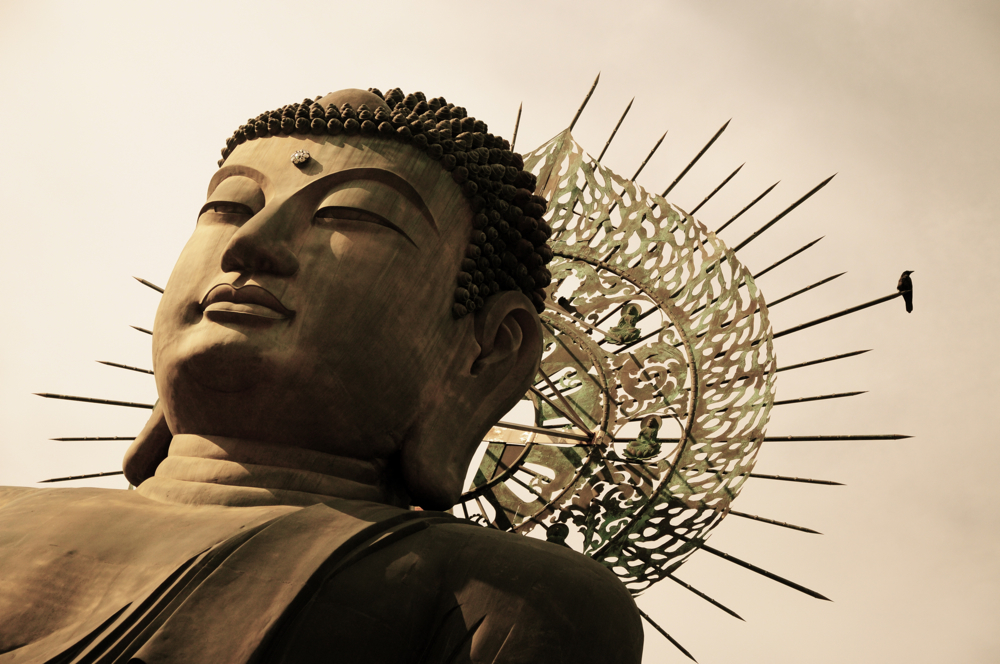
Buddha with bird, CC*BY Ekke

Contemplating Nature

I finished Birding with Buddha this month. It is designed to accompany the course I taught this spring, and it's not really meant to stand alone, but see notes below to acquire a free copy.

It was a modest undertaking and yet it has taken me awhile. I taught it first as a course, Zen Birding, in 2011, and again this spring, as Birding with Buddha, my research project for a Master's Degree in Contemplative Education from Naropa University. I refined it a lot over the last three years, partly as a result of the things I learned teaching it. But I read so many wonderful articles and books over the course of my studies at Naropa that I knew would enrich the text immeasurably, that it's a very good thing that I was able to make it my research project and stretch out the time to sit with it, so to speak. I know it is better for the time I've spent at Naropa.

Now what?

I really don't know. That's supposed to be a good thing. It is what it is.

If you would like a copy of Birding with Buddha

Birding with Buddha is available in the iBookstore, or you can download it here. I wrote the book in iBooks Author, so it is formatted for the iBooks reader. If you visit this page and press and hold the link in Safari on your iPad or other device with iBooks reader installed, Safari should give you the option to open the file with iBooks. But if you access the link from your computer, whether Mac or PC, just download it and either sync it to your iPad iBooks reader or email it to yourself and open the attachment on the iPad with iBooks. Best of luck!

A pdf is available too, even though it is not so good an alternative. The sounds in Chapter 3 do not play in the pdf format. I would suggest that the reader listen to any bird sounds in place of the recordings -- whatever is chirping outside your window.


Sunday, April 22, 2012

A day of contemplation in the garden

Photo: CC*BY FlyingSinger
Today is Earth Day. I am spending as much of it as I can outside just being in the garden. With my cat. She's so laid back.

Kitty Girl
What luck! We're joined there by the Austin symphony of spring birds playing their best solos -- its the spring breeding season and no one wants to be ignored. Over the course of this single day I've heard, in no particular order, Chuck-will's-widow, Summer tanager, Louisiana waterthrush, White-eyed vireo, Golden-cheeked warbler, Nashville warbler, Northern cardinal, Spotted towhee, House finch, Lesser goldfinch, Black-crested titmouse, Carolina chickadee, Carolina wren, Great-horned owl, Great-crested flycatcher, Black-chinned hummingbird, Eastern phoebe, White-winged dove, Purple martin, Blue-gray gnatcatcher. I must be forgetting somebody.

And there are a few that seem to be missing. Where are the Blue jays, the Northern mockingbirds and the Chimney swifts? What about the Bewick's wren and the Red-eyed vireo? I heard them yesterday. Well, so it goes.

Photo: CC*BY .:[Melissa]:.
I hope I never forget how beautiful a place this is, how sweet and fresh the air, how delicate the web of activity that brings it all to life in an unending process of birth, growth, decay, death and renewal. Like those little 8-spotted Forester moths that showed up recently, innocently hanging out around the Virginia creeper. And then a few weeks later, what? What on earth is skeletonizing the Virginia creeper -- oh -- it's a little caterpillar, which I look up and find is ... 8-spotted Forester moth larvae. Of course. And the birds love to eat the caterpillars. And I learned today that it's no surprise that the Summer tanagers hang out here. We have a bee-hive in the side of our cliff and Summer tanagers eat, yes, bees. Their favorite thing. It's like poetry only more beautiful and without words.

Saturday, April 21, 2012

Reflecting on a symposium


I attended a symposium in mid-April. Following are my notes about and reflections on one of the panel discussions. You can find the traditional takes on the conference, and the presenters' materials, as well as a treasure trove of resources at the Symposium Website.

My notes, however, in poetry form, convey something different, something unlike a typical set of notes from a conference. I listened and watched utilizing the practice called contemplative observation -- seeing what the senses perceive, how the mind reacts with thoughts and feelings, and which body sensations the whole experience evokes. The contemplative education department at Naropa University teaches the practice, developed by Richard C. Brown. It helps integrate the benefits of a meditation practice into daily life. Most importantly, one learns as much about oneself as about the events taking place in the surrounding space.

It is somewhat like Birding with Buddha, observing contemplatively "to see beyond ordinary thinking to a wordless awareness that unites us with all phenomena in the all-encompassing process that life is" (Harper, 2011).

So, it may sound a little crazy, and it is, but that's what keeps the practice interesting. Enjoy!

Life symposium -- see, oppose, breathe, rest, accept


Perception

The room a mix of art deco drab brown and tan
Participants -- black and dark shades of blue and gray
The speakers all men, the audience mixed, but mostly men
The first speaker’s tenor is witty and frank
His voice, high-pitched as he admits his earlier naïveté, plaintively advocates letting things sit and allowing people to "bolden-up" (which he knows we all have in the last ten years)
“Congress screws up when it tries to deal with the future, rather than settle disputes of the past”
Ambiguity is slack in the system; he likes that

Reflection

Me too

Perception

We sit around large round tables, all facing the stage, quite still, some heads bowed, like mine while I type
Sipping coffee

Reflection 

Barely breathing, shallow, cramped breaths
I remind myself to breathe; I forget to breathe
I notice that my shoulders are hunched
I lower them 
They creep back up
When the speaker makes jokes I laugh and some of the tension dissolves
Then it comes right back

I wonder, “Am I the only person in jeans?”
Ah, a guy, an earring, and jeans
Breathe
I am not at home with these still black, blue and gray guys

But only moments ago -- embraces, kisses, laughs and joyful chatter graced and filled and expanded and warmed the space
No one else is really here
Only old friends; 20 years of practice
Twenty years of practicing… what? And what for?

That sinking feeling
I’m overwhelmed
What did he just say?
Fear of missing an important and relevant fact
There’s just too much
See, I'm holding my breath – oh that helps…

Ah, but there's a different way to see, to hear, to know
I straighten up; I breathe, raise my chin, raise my eyes
The room is still the same
It's still, really still
Quiet
Thoughtful
Everyone here cares, even industry
A lot
I could not have seen that before clear seeing, heart knowing

Register wants to amend Section 108
My opposition, a surprise
I don’t care, do I?
I wish not
Breathe -- I do
I see that now

Suddenly I notice -- my clothes so tight around me
They squeeze my chest, my arms, my legs, my back
When the speaker says “I saved this!”
I smile
I smile, laugh and really listen
I do not feel so overwhelmed
I lose self-consciousness
I don’t feel squeezed
But then preoccupation returns

Perception

He’s ranting

Reflection

Does he not see
So SNCC is defunct – so there is no one to complain
His risk is zero, or close to it; he need not worry so
Sit down; shut up
I need to move around
I have been sitting too long

Perception

Rick Prelinger – wearing a tux? No, but
Polished silver hair, parted down the middle
A fabulous sense of humor
Security through obscurity; he collects ephemera

Reflection

Ephemera, like the color of his hair, my skin, our positions, our health
Like thoughts, like feelings, “like clouds in a windy sky” as Hanh (2006, p. 53) says of feelings
Hmmm
He collects ephemera; not wanting to let it go
It’s what librarians do; saving things for others to see, to touch, to feel, to listen to, to learn from – ordinary prajna
I lean against the chair back
Breathe easier
The puzzle is so complex; my part of it so small; I smile about that; not so much to worry about after all

But people who want to remodel their homes must petition the copyright board in Canada for permission to reproduce their own blueprints
How screwed up is that?

Perception

Prelinger makes the 1%/99% argument
The third speaker to make it
We get it, but…

Reflection

He is the best, making his argument so eloquently, still, outside this room, no one will listen to him
Congress will solve the 1%’s problem
The rest of us be damned, and we will be ignored
Whether we speak eloquently, with wit and charm, or yell and rant and curse them and their horses and dogs and children
This is the way it is here
I read today about icebergs making slow slides into the sea, speeding up more than we thought
And so it will go, all of it

Concluding Reflection


Observing a panel session at a conference in this way, contemplating, not just listening to, what is being said, but also the manner of its presentation, the attitude of the audience, the engagement across the divide between podium and floor, and my moment-to-moment formulation of various responses to it – in my body and my mind, my thoughts, feelings, sensations, the ups and downs of the flow of my energy – this is priceless.

Aware of my self, of the space, of what is going on across the field of sense perceptions, I come to a new understanding of how to communicate with those with whom I work who want to know about copyright law.  I think differently with the part of my brain that does not always need words to inform me, I trust in a process other than analysis and synthesis to respond to others. I see that ordinary analysis and synthesis, while quite valuable, are nevertheless dualistic, so they are not all there is.

Contemplative observation allows me to glimpse the field of being where we’re all really in this together. Presence is the key. "When someone opens completely to what they are experiencing, the personality -- which is an activity of judgment, control, and resistance -- disappears for a moment" (Welwood, 2000, p. 103). And I need those moments of full presence, those glimpses of clear seeing to help me touch lightly the sadness I feel when I think about all the pain we experience, the achingly beautiful world we share, and how we must all let it all go, one by one. I can balance with this a little better each day. I am so grateful.

The ultimate practice here is learning to remain fully present and awake in the middle of whatever thoughts, feelings, perceptions, or sensations are occurring and to appreciate them, in Mahamudra/Dzogchen terms, as Dharmakaya -- as an ornamental display of the empty, luminous essence of awareness. They are the radiant clarity of awareness in action (Ibid., p. 106).

References

Hanh, T. N. (2006). Present moment wonderful moment: Mindfulness verses for daily living (2nd ed.). Berkeley, CA: Parallax Press.

Harper, G. (2011, March 8). Zen birding. Lifelong learning. Retrieved from http://georgiaharper.blogspot.com/2011/03/zen-birding.html

Welwood, J. (2000). Dialectic of awakening. In T. Hart (Ed.), Transpersonal knowing: exploring the horizon of consciousness (pp. 85–106). New York, NY: SUNY Press.

Friday, August 05, 2011

Traditions

Yesterday and this morning, I became part of a long-standing tradition: I chose Chinese medicine to treat a health condition.

I've ended up over the course of the last 3 months with a really bad cough. I checked with my doctor and she noted that since my allergy meds, taken regularly, have done nothing to remedy the cough, it's fair to assume it's not caused by allergies. But I also have asthma. She thought that the really hot, dry and windy conditions we're experiencing here in Austin (and that I also experienced in Colorado, at least the dry and windy part of it) exacerbate asthma symptoms. She's been hearing a lot of complaints from her patients with asthma. So, she suggested I try an asthma inhaler that reduces inflammation, which I agreed to do. I have tried them before, and they really do improve my breathing.

My asthma herbs & other healthy things
CC*BY GKH
But I also went to see Billy, my acupuncturist, got a treatment, signed up for a weekly series of them for awhile, and got three little paper bags full of Chinese herbs from the Turtle Dragon shop down the street from his office.

Billy prescribed Chinese herbs once before when I had a really bad case of bronchitis, and I recalled mainly that they tasted awful. These aren't the same ones. I brewed them up this morning and to my surprise, they tasted rather good. Well, maybe it was the three slices of fresh ginger I added to them (part of the recipe!). But in any event, the tea was very nice. I will take this medicine 30 minutes after each meal for the next 6 days. Then we'll see about that inhaler.

Chinese herb shop
CC*BY Jimmyhomeschoolmom
So, I'm not Chinese. So I've never been to China. It's still tradition. And I like tradition. And I would love for these treatments to tame this cough. If they don't, well that's ok. Best to try though, before I embrace the western approach. The inhaler contains an ingredient that, according to the mile-long insert in the box, "increases asthma-related deaths." Hmmm. I am pretty sure the inhaler will work, and I'm pretty sure that, odds are, I'm not going to suffer unreasonably with side-effects, but geez, some of them can be real doozies.

Sunday, July 31, 2011

Getting a little perspective on your yard birds

As I packed for my summer trip to Boulder, I planned to bring my binoculars and bird book, but at the last minute, I put them both away, recognizing that I wasn't going to have time for birding. Boulder was not a birding trip. Nonetheless, when I first arrived, I noticed right away that there were many new unfamiliar bird sounds as well as some that I knew but which were slightly different, suggesting maybe a different but related species to the ones I was familiar with at home. I just listened.

Flatirons, Chautauqua
 GKH CC*BY
Little by little I got better at just listening, and on a day trip to Chautauqua, I sat in the woods along the trail into the Flatirons just listening. It truly was a musical delight. Only once or twice did my mind grab onto a label, or my eyes wander to the source of sound.

But I did find it odd that I couldn't see any of the birds.

James Good
CC*BY*NC*ND
Gradually that changed. I saw a Red-shafted Northern Flicker's flight feather on the ground on my walk home one morning and picked it up. I had heard them in the trees at the entrance to our building, Lincoln Hall, but I never saw them.

Coby Leuschke
CC*BY*NC*ND
Then one morning, a Hummingbird made an appearance, calling an alarm above the flowering plants around the trees at the entrance to Lincoln. I noticed that the leaves of the plants below her were waving in a pattern that at first suggested they were being fanned by her wingbeats. It took a few seconds for me to realize that something was on the ground at the base of those plants, hidden from view. Its movement along the ground caused the tops of the plants to wave. It had her quite riled up. I never discovered what it was, however, because I was about to be late to morning mediation, so I left the mystery unsolved when she flew away.

A few days later, a flock of Chickadees appeared in the trees visible through one of the windows of Shambhala Hall, our mediation room. I could tell that they weren't Carolinas, but unsure of what they were, I just listened and watched. Later, a female House Finch appeared on the roof of our apartments, in the courtyard.

Robins in Snow Lion Courtyard -- Liz Sloan
And then I noticed a female American Robin sitting on a nest in the courtyard. She eventually hatched and fledged three babies.

One day Crows and Ravens showed their tails in flight so I could tell them apart without binoculars, even without glasses. And then, on an afternoon walk, I heard the sound of the Flicker in a tree above me and looked up and saw him in a hole in one of the branches of the tree. These occasional sightings always made me feel happy and present. But beyond the occasional squirrel or raccoon on campus, and these few birds, the wildlife in Boulder was sparse to say the least.

Home garden -- GKH CC*BY
I guess I got used to it. When I got home to Austin, my first morning in the garden astounded me with the variety and numbers of birds, squirrels, lizards, snakes and frogs I saw and heard within the first few hours of waking up! Critters were everywhere -- on the ground, in the trees, in the sky, at the feeders, on the bird baths. Unperturbed and raucous, they went about their business as though I weren't there. It was the best welcome home I could imagine! Well, that and the fact that Dennis had kept my garden alive and thriving, the feeders filled, and the bird baths clean and inviting the whole time I'd been gone. No wonder the critters were at home.

I had to remind myself that these were the same birds, lizards and squirrels that I had been noting somewhat dismissively before I went to Boulder, as my usual yard inhabitants. What a difference a little perspective can make.

Saturday, July 23, 2011

Why Meditate?

From Center for Contemplative Mind in Society
Morning and afternoon meditation were a constant in our lives at Naropa University this summer. Coming to this as I did from having meditated "off and on" for roughly 40 years, the regularity (in the past I might have said "rigidity") of the Naropa schedule was challenging at first. It quickly became a comfort, however, like a base, a simple practice to return to from wherever I went spinning off.

Shambhala Sun,
Sept. 2010
One of our first readings was Matthieu Ricard's "Why Meditate?" (2010), which I read several times during the course of the semester, each time understanding it differently. By the end of the semester, I had come to appreciate meditation in a way I never had before. Ricard described its centrality with straightforward and powerful words: “If we want to observe the subtlest mechanisms of our mental functioning and have an effect on them, we absolutely must refine our powers of looking inward” and “… cultivate a way of being that is not subject to the patterns of habitual thinking” (pp. 41 and 86).

More simply put, daily practice on the cushion is necessary to sharpen the ability to notice. And noticing is the foundation of all learning, insight and wisdom. So, for example, meditation helped me better notice myself reacting in habitual ways in day-to-day activities. I noticed my thoughts while washing the dishes. I saw subtle complaints, clinging to opinions, nostalgic reminiscing, and many others. This "just noticing" allows for questioning, looking deeper into those habitual thought patterns, for "just noticing" what hides beneath the surface of things that “get me,” or take me off to the past, or into the future.

Refining my attention and practicing mindfulness enabled me to see that even within the impulse I have to help, to inform, to counsel and to solve problems (in other words, the impulse to teach and to counsel my clients) is a subtle aggression, a desire to make problems go away. This came as a real surprise. But noticing it allowed me to consider refining my approach to teaching and to counseling, to "cultivate a way of being that is not subject to the patterns of habitual thinking" (Ricard, 2010, p. 86). Sometimes problems will not go away...

And Ricard pointed out something else just as foundational about meditation -- that while we can read the words of scholars and practitioners who have devoted their lives to “observing the automatic, mechanical patterns of thought and the nature of consciousness,” ... “we cannot merely rely on their words to free ourselves ... We must discover for ourselves the value of the methods these wise people taught and confirm for ourselves the conclusions they reached. This is not purely an intellectual process. Long study of our own experience is needed to rediscover their answers and integrate them into ourselves on a deep level” (pp. 86-87). In other words, you can't think your way to everything.

My Naropa journal came to contain many examples of my noticing that it wasn't all about thinking, that things happened in the gap, in the space between thoughts, and while I wasn't thinking:
I notice coincidence, repetition, and synergy here. For example, I hear "Heart Sutra" three times over the course of two days, so I Google, 'Heart Sutra commentary,' and up comes an amazing talk by Dr. John Crook, whom I've never heard of, posted on a UK site called Western Chan Fellowship, equally unknown to me. I read a little and then I leave it alone. I read more and then I leave it alone. It takes two days to finish it. I don't think about it. I am very present while I am reading. I feel my breathing slowing down, I feel my shoulders relaxing, my back straightening, at times I feel filled with energy, other times I am more empty and open. Some of his words trigger memories. There is recognition at times. And then there is ‘I don’t know.’ Then there is Richard (our instructor) saying, "you have to find out what is there before you worry about the fact that it's not there.” The Heart Sutra is about not here, not there, not anywhere. I don't want to think about it, I just want to hear it. Today I heard (noticed) this:
‘The essential feature of this approach is to realize that it is based in meditation. Thought can raise innumerable objections and create endless metaphysical speculation. The Buddha is speaking out of his enlightenment. He is sharing it, transmitting it. To receive it one has to follow the same path’ (Crook, 1992, part 2, para. 13).
I can't think my way to this (Personal Journal Entry, July 9, 2011).
Even more to the point:
We repeated the same improv performances in Presence class today three times, focusing on the same element each time. I got bored (predictably). The third time, Lee (our instructor) added an audience, and suggested that "we" get out of the way this time ("I've done every thing I know how to do in this role with this element"). She was right. Wow.
The element was fire. I may have undervalued and diminished it's power in my life somehow. But it is there. My performance of fire came from somewhere other than thinking it up. Lee would say, it came from nothing, from space, from the ground. I discovered three things about fire by thoroughly being fire for that third time, for those six minutes.
1. It is explosive. It uses things up. It takes one thing, combines it with another, and transforms both through explosion. Nothing is the same after fire touches it. 
2. It is passionate. It is heat, lust and desire. It consumes and exhausts in its uncontrolled raging energy. 
3. But harnessed, it radiates warmth, life-giving energy and the spark that starts things growing and changing. 
It relates the things it consumes to each other. It joins them in energetic exchange. Fire only exists through connections: fire connects the earth element of fuel and the heaven element of air. It is the dynamic connection between heaven and earth. Its hard to imagine that I am or even have that connection inside me. But I was fire today. I have fire and can call upon and use its energy (Personal Journal Entry, July 4, 2011).
Given my careers in academe and in law, where logical thought is so highly valued, Crook's and Ricard's words, and my experiences with the Naropa summer learning intensive, are stunning confirmation of the importance of intuitive understanding. The Heart Sutra presents a very esoteric understanding of the nature of reality, and it’s pretty hard for me to grasp, but I'm convinced I won't get there by just thinking my way to it. “This approach is … based in meditation. Thought can raise innumerable objections and create endless metaphysical speculation..." (emphasis mine).

Indeed.

So, it's trusting more than just that part of my being that is analytical and strictly logical. It's about giving a say to Jill Bolte Taylor's, "Stroke of Insight." Theoretically, I get this. But where the rubber meets the road, it is not easy to trust beyond what you're comfortable trusting.

That's when it's back to the basics. Seeing how dramatic a difference being present makes, and how effectively meditation is sharpening my ability to see things I simply have not seen any other way, I am very reassured. Maintaining a regular meditation practice is absolutely essential to this seeing. Trust in the process is essential.

And today I read, by a sad coincidence perhaps, that Dr. John Crook died on Saturday, the last day of our semester. I am learning to bow to and trust those who teach. They know what they're talking about.

References
Crook, J. (1992, November). The heart sutra - A commentary - Dharma talk by John Crook. Western Chan Fellowship. Retrieved July 9, 2011, from http://www.westernchanfellowship.org/heart-sutra-commentary.html
Ricard, M. (2010, September). Why meditate? (How to meditate). Shambhala Sun. Retrieved July 23, 2011, from http://www.shambhalasun.com/index.php?option=com_content&task=view&id=3575&Itemid=0
Taylor, J. B. (2006). My stroke of insight: A brain scientist’s personal journey. Lulu.com.